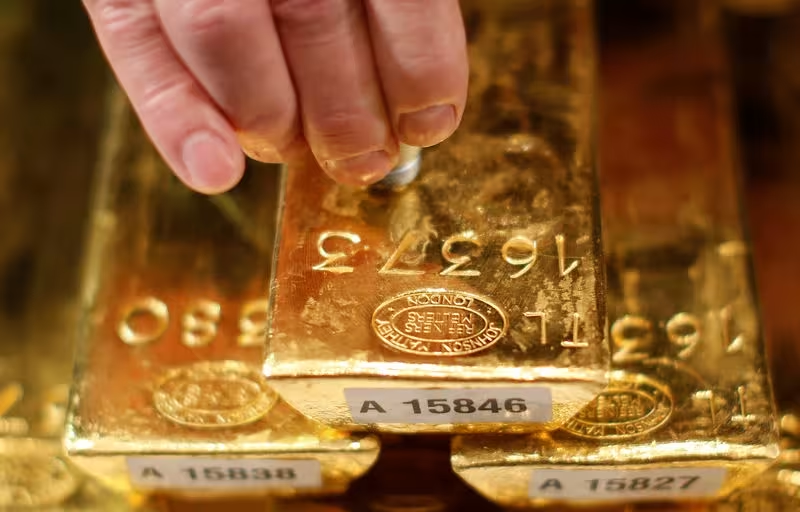
Gold prices retreated sharply on Tuesday, extending recent volatility in precious metals markets as investors adopted a cautious stance ahead of a critical U.S. inflation report. Market participants are closely watching upcoming consumer price data for clues about the future trajectory of interest rates and monetary policy. At the same time, renewed geopolitical tensions in the Middle East added another layer of uncertainty to global financial markets. Although gold traditionally benefits from risk-off sentiment, expectations surrounding inflation and interest rates dominated trading activity, pushing bullion prices lower. The decline highlights the delicate balance between economic indicators and geopolitical developments in shaping investor behavior.
Gold Faces Selling Pressure Ahead of Inflation Report
Gold prices registered a significant decline on Tuesday as traders repositioned portfolios ahead of a closely watched U.S. consumer inflation report that could influence monetary policy expectations in the world's largest economy.
Spot gold fell approximately 1.6% to $4,260.20 per ounce, while gold futures declined 1.8% to $4,284.09 per ounce. The pullback reflects heightened caution among investors seeking greater clarity on inflation trends and the potential response from policymakers.
Market participants have increasingly focused on economic data releases, recognizing that inflation readings remain one of the most important determinants of future interest-rate decisions. Any indication of persistent price pressures could alter expectations regarding the timing and magnitude of policy adjustments.
Interest Rate Outlook Remains the Key Driver
The precious metals market continues to be highly sensitive to changes in interest-rate expectations. Gold, which does not generate interest income, often faces headwinds when investors anticipate elevated borrowing costs or higher yields from fixed-income assets.
Analysts note that inflation data has become a critical catalyst for market direction. Stronger-than-expected inflation figures could reinforce expectations that policymakers may maintain restrictive monetary conditions for longer, potentially reducing the appeal of non-yielding assets such as gold.
Conversely, signs of moderating inflation could revive hopes for a more accommodative policy environment, providing support for bullion prices in the medium term.
Geopolitical Tensions Add Complexity to Market Sentiment
Alongside economic concerns, investors are also monitoring developments in the Middle East following fresh geopolitical tensions involving the United States and Iran.
Comments from U.S. President Donald Trump regarding military developments in the region contributed to broader market uncertainty and heightened investor caution. Such geopolitical events typically encourage demand for safe-haven assets, including gold.
However, Tuesday's trading session demonstrated that macroeconomic expectations currently hold greater influence over precious metal pricing than geopolitical developments. The market's focus remains firmly fixed on inflation trends and their implications for global financial conditions.
Recent Market Volatility Highlights Investor Uncertainty
The latest decline follows a period of increased volatility in the gold market. During the previous trading session, bullion prices briefly touched their lowest levels since late March before recovering a significant portion of losses by the close.
This pattern reflects ongoing uncertainty among investors attempting to assess competing forces affecting the precious metals market. On one hand, geopolitical risks continue to support demand for defensive assets. On the other, expectations surrounding inflation, economic growth and monetary policy remain dominant market drivers.
The result has been heightened price fluctuations as traders react to rapidly evolving information.
What Investors Should Watch Next
The upcoming inflation report is expected to serve as the next major catalyst for gold prices. Financial markets will closely scrutinize the data for evidence regarding the persistence of inflationary pressures and the likely direction of future policy decisions.
Should inflation remain elevated, gold could face additional near-term pressure as expectations for higher interest rates strengthen. However, any indication that inflation is cooling faster than anticipated may reignite demand for the metal and improve its investment appeal.
For now, investors appear content to remain cautious, waiting for clearer economic signals before making significant portfolio adjustments.
Outlook for Precious Metals
Despite the recent decline, gold remains one of the world's most closely watched safe-haven assets and continues to play an important role in portfolio diversification strategies. Long-term demand remains supported by central bank purchases, geopolitical uncertainties and concerns surrounding global economic stability.
However, short-term performance is likely to remain heavily influenced by inflation data, interest-rate expectations and broader macroeconomic developments. As markets await fresh economic signals, volatility is expected to persist, keeping investors focused on both economic fundamentals and geopolitical risks.
The coming days may prove pivotal in determining whether gold resumes its longer-term upward trajectory or faces further consolidation amid shifting monetary policy expectations.
Comments